
UPSC Tips
Get focused strategies tailored for UPSC exam success and time management.

Exam Guidance
Step-by-step ips and resources tailored for UPSC aspirants.
Major Functions of UPSC
UPSC conducts recruitment examinations for numerous Central Government.
UPSC Insights
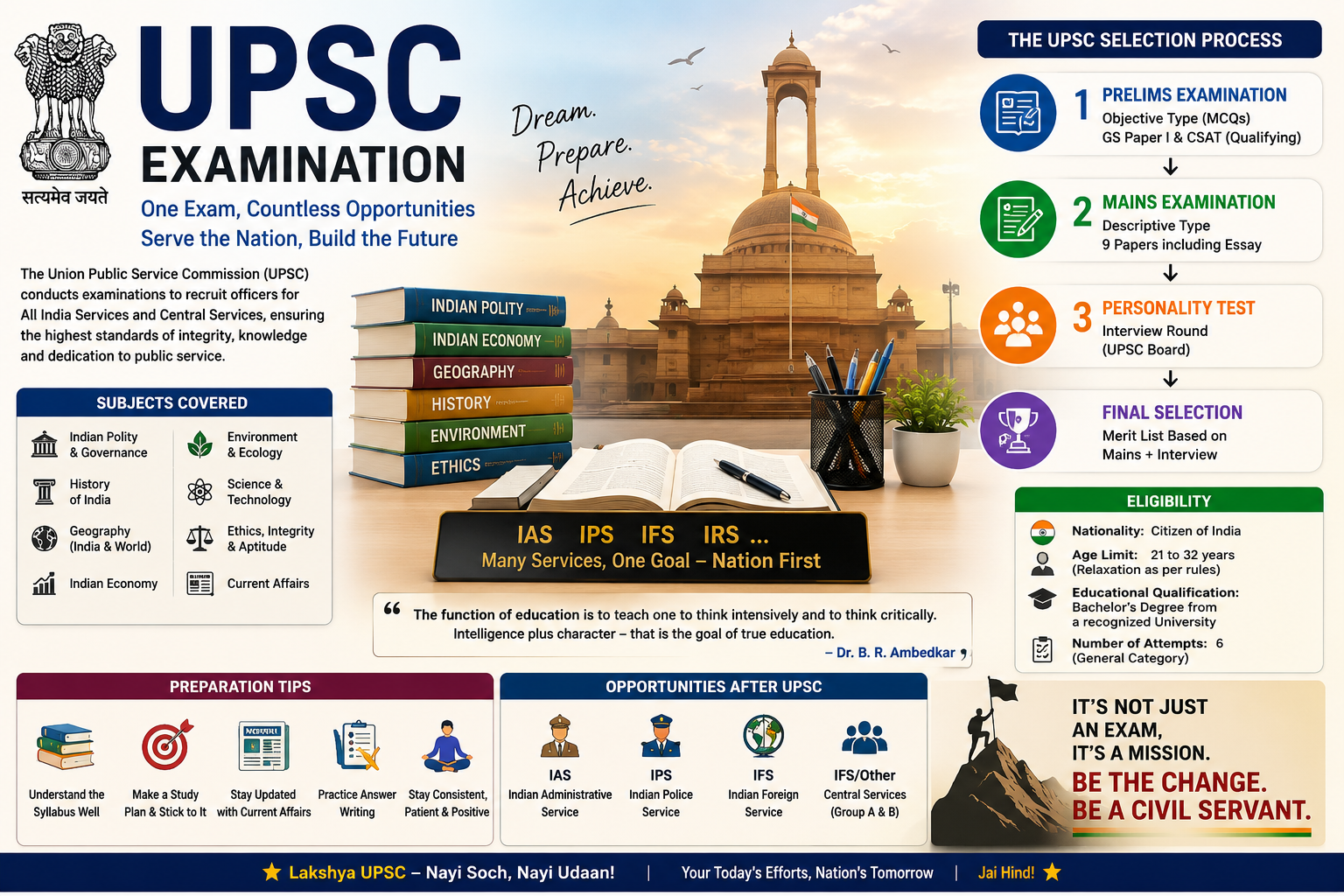
UPSC Exam Guidance
Helpful tips and resources tailored for UPSC aspirants.
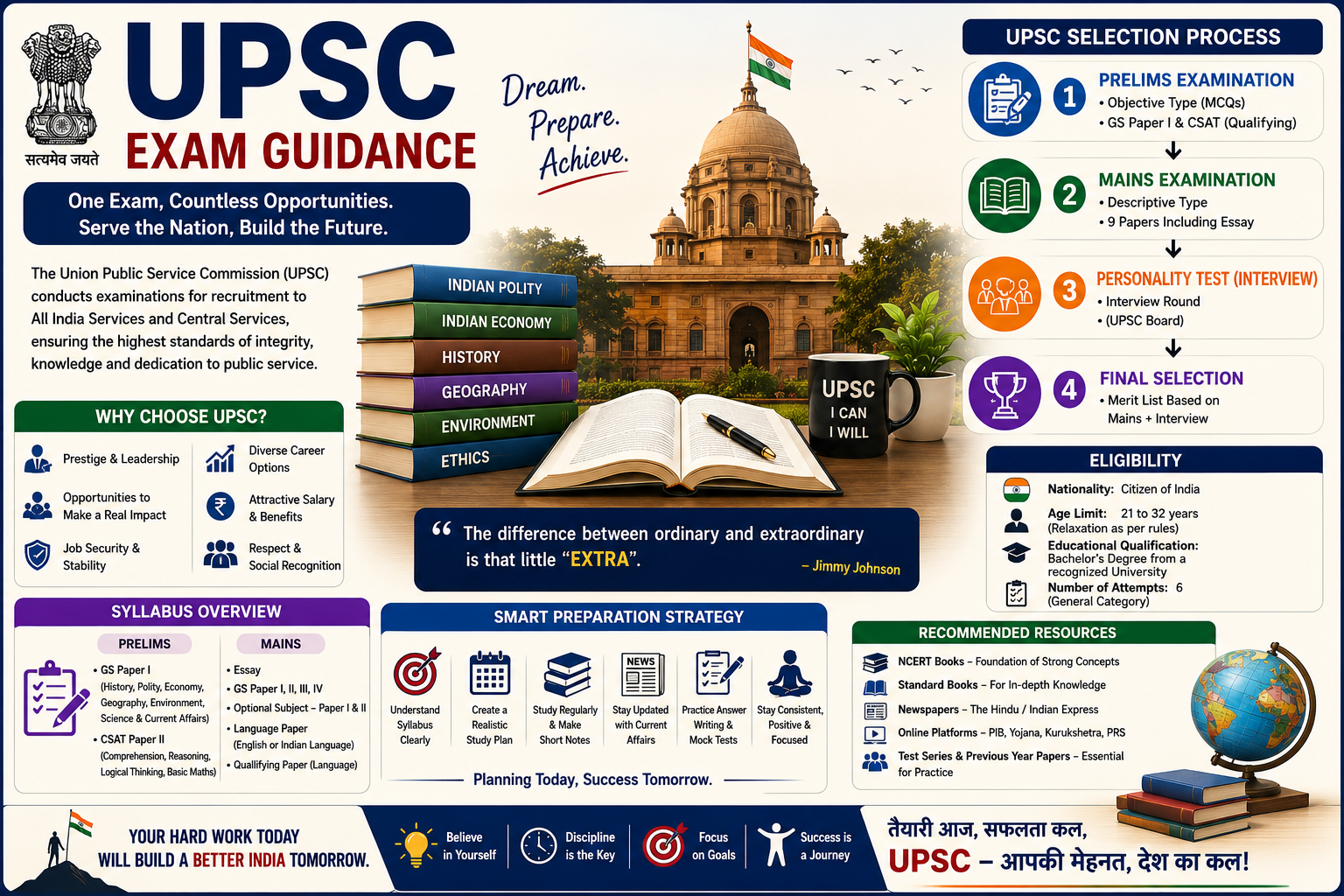
Union Public Service Commission
(UPSC)
The Union Public Service Commission (UPSC) is India’s premier constitutional recruiting agency responsible for selecting officers for the All India Services and various Central Civil Services of the Government of India. It is widely regarded as one of the most prestigious public service commissions in the world.
Historical Background
Origin During British Rule
The idea of a public service commission in India emerged during British rule.
Important milestones:
- 1924: The Lee Commission recommended the establishment of a Public Service Commission.
- 1926: The first Public Service Commission was established in India.
- 1935: The Government of India Act provided for a Federal Public Service Commission.
- 26 January 1950: After the Constitution of India came into force, the Federal Public Service Commission became the Union Public Service Commission (UPSC).
Constitutional Status
UPSC is a constitutional body established under:
Part XIV of the Constitution of India
Articles 315 to 323
These articles define:
- Formation of Public Service Commissions
- Appointment and removal of members
- Powers and functions
- Independence and safeguards
This constitutional protection helps UPSC function independently of political influence.
Headquarters
The headquarters of UPSC is located at:
Dholpur House
Dholpur House was originally the residence of the Maharaja of Dholpur and later became the headquarters of UPSC.
Composition of UPSC
UPSC consists of:
- A Chairman
- Several Members
Appointment
The Chairman and Members are appointed by the President of India.
Tenure
A member serves:
- For six years, or
- Until attaining the age of 65 years, whichever is earlier.
Major Functions of UPSC
1. Conducting Examinations
UPSC conducts recruitment examinations for numerous Central Government services.
Civil Services Examination (CSE)
This is the most famous examination conducted by UPSC.
Through CSE, candidates are recruited to:
All India Services
- Indian Administrative Service (IAS)
- Indian Police Service (IPS)
- Indian Forest Service (IFoS)
Central Civil Services
- Indian Foreign Service (IFS)
- Indian Revenue Service (IRS)
- Indian Audit and Accounts Service (IA&AS)
- Indian Defence Accounts Service (IDAS)
- Indian Information Service (IIS)
- Indian Trade Service (ITS)
- Indian Corporate Law Service (ICLS)
- And many others
- Recruitment Through Selection
UPSC recruits officers through:
- Written examinations
- Interviews
- Personality tests
- Direct recruitment
- Selection by promotion
- Deputation processes
- Advising the Government
UPSC advises the Government of India on:
- Recruitment methods
- Promotion policies
- Transfers
- Service rules
- Disciplinary matters
- Pension claims in certain cases
- Departmental Promotions
UPSC participates in the promotion of officers from State Services and Group B Services to higher ranks in Central Services.
Civil Services Examination (CSE)
The Civil Services Examination is popularly known as the IAS Exam.
Stage 1: Preliminary Examination
General Studies Paper-I
Topics include:
- History
- Geography
- Polity
- Economy
- Environment
- Science & Technology
- Current Affairs
CSAT (Paper-II)
Tests:
- Comprehension
- Logical reasoning
- Decision-making
- Quantitative aptitude
Stage 2: Main Examination
The Main Examination is descriptive in nature.
It includes:
- Essay
- General Studies Papers
- Language Papers
- Optional Subject Paper(s)
The examination tests analytical ability, writing skills, and depth of knowledge.
Stage 3: Personality Test (Interview)
Conducted at UPSC headquarters in New Delhi.
The interview assesses:
- Mental alertness
- Judgment
- Leadership qualities
- Integrity
- Administrative aptitude
- Social awareness
- Communication skills
Other Important UPSC Examinations
Besides CSE, UPSC conducts many national-level examinations.
Engineering Services Examination (ESE)
For recruitment of engineers in:
- Railways
- Defence
- Central Engineering Services
Combined Defence Services (CDS)
For entry into:
- Indian Military Academy (IMA)
- Indian Naval Academy (INA)
- Air Force Academy (AFA)
- Officers Training Academy (OTA)
National Defence Academy (NDA)
For admission to:
- Army Wing
- Navy Wing
- Air Force Wing
of the National Defence Academy.
Indian Forest Service Examination (IFoS)
For recruitment to the Indian Forest Service.
Combined Medical Services (CMS)
For recruitment of doctors in Central Government services.
CAPF (Assistant Commandant)
For recruitment of officers in:
- BSF
- CRPF
- CISF
- ITBP
- SSB
Geologist Examination
For recruitment of:
- Geologists
- Geophysicists
- Hydrogeologists
Qualities Expected in a Civil Servant
UPSC seeks candidates possessing:
- Integrity
- Leadership
- Public service orientation
- Decision-making ability
- Emotional intelligence
- Constitutional values
- Problem-solving skills
- Ethical conduct
Importance of UPSC
UPSC plays a critical role in Indian democracy by:
- Recruiting competent administrators
- Ensuring merit-based selection
- Maintaining neutrality in public service recruitment
- Strengthening governance and public administration
- Supporting the implementation of government policies
UPSC and Nation Building
UPSC-selected officers serve across India in roles that influence:
- Law and order
- Education
- Health
- Rural development
- Foreign relations
- Tax administration
- Environmental protection
- Disaster management
- Economic planning
These officers form the backbone of India’s administrative machinery and contribute significantly to national development and governance.
In simple terms, UPSC is the constitutional institution that selects many of India’s top civil servants and administrative leaders through a rigorous, merit-based examination and selection process.
UPSC Guidelines
UPSC guidelines encompass a broad range of rules for the Civil Services Examination (CSE). These guidelines apply to eligibility, the application process, and exam day conduct
Eligibility requires candidates to be between 21 and 32 years old (with category-specific relaxations) and possess a degree from a recognized university. Candidates are permitted a capped number of attempts based on their category: 6 for General, 9 for OBC, and unlimited for SC/ST.
Key Application Guidelines
Candidates must register via the Universal Registration System (URS) on the official portal. The following strict photo and signature rules apply:
Photograph: Must be in JPG format, 20 KB to 200 KB, against a plain white background. The face must cover 75% of the image, with both ears clearly visible. Live photograph capture is also mandatory during application.
Signature: Must be in black ink on white paper, 20 KB to 100 KB, containing exactly three vertically arranged signatures. Blue ink, ruled paper, or cropped images will lead to application rejection.
Exam Day Guidelines
- Admit Card & ID: Carry a printed copy of the UPSC Admit Card and an original, valid government photo ID (Aadhaar, PAN, Voter ID, etc.).
- Reporting Time: The entry gate closes exactly 10 minutes prior to the commencement of each session. Late entry is strictly prohibited.
- Stationery: Only black ballpoint pens are permitted for marking OMR sheets.
- Prohibited Items: Electronic devices, including smartwatches, mobile phones, and calculators, are strictly banned from the examination premises.